Education and Covid-19

I was watching a news clip on how some students and pupils cannot access any education material during this period of school shutdowns because of the covid-19 pandemic. These students do not have access to smartphones or televisions in their homes. The clip included a young girl pleading with the government to provide a smartphone to her parent so that she could continue learning.

There are a number of measures that the government has taken, these include working with education agencies to create content that is aired on television channels like EduTV and radio stations. A number of my friends (techies) mocked the plan to air content via radio, what they don’t realize is how many people have access to radio compared to other form of mass communication.

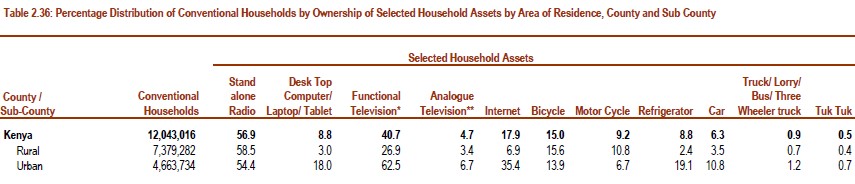
Looking at Volume 4 of the Kenya Housing and Population Census 2019, 56.9% of the population have access to radio while 8.8% has access to computer/laptop/tablet and only 17.9% have internet access. Report can be found here https://www.knbs.or.ke/?wpdmpro=2019-kenya-population-and-housing-census-volume-iv-distribution-of-population-by-socio-economic-characteristics
89904620_10158105226773664_2095504519264731136_n

In the month of October and November of 2019, I was involved in a program that introduced computer science clubs to primary schools. I choose to help in Kilifi & Malindi counties, I realised the tablets were not in use but we cleaned them up and started using them. It worked out for the 6 weeks. The pupils were excited and played with Scratch, the programming platform developed at M.I.T. There was a education technology startup that was providing access to education content. What I noticed is that the students were curious and quick to learn their way around the tablets. These tablets were introduced through the Ministry of ICT in the government of Kenya. Internet connectivity was a huge challenge as some of the schools were in very remote areas.

The government of Kenya already has this devices within the schools, I believe this is where we can start from and scale across the country to all schools. We can develop offline content to be accessible on the tablets with a priority on class 8 and form four students. I am aware of the fact that electricity to recharge the devices might be an issue, in this case I would suggest a routine to get the devices back from the students, recharge them and return them to the students.

In the past, I have seen startups that offer education content via interactive SMS but they were limited to tests to evaluate students comprehension. Looking forward to see what the government does to take care of students who don’t have smart devices and internet connectivity to access education content.

The challenge with this suggestion is; are the students able to use the tablets? I welcome your thoughts on this post in the comments section.

Follow me on twitter @bmwasaru

9 responses to “Education and Covid-19”

  1. Shufaa Avatar
    Shufaa

    This is a very good thought. The project can be workable if teachers and parents collaborate to put the candidates in mind.

    1. bmwasaru Avatar
      bmwasaru

      I agree. Collaboration will be required to get the students back to learning. Something I am sure teachers are willing to do.

  2. Robert Avatar
    Robert

    This is the way to go. Am not sure if the majority of students are able to use tablets but I believe they can Learn this as well with help from guardians and teachers. Its a collective responsibility

    1. bmwasaru Avatar
      bmwasaru

      I agree 💯

  3. issaziri Avatar
    issaziri

    Here’s a thought.

    With the current pandemic, most students have taken this a holiday. Now, bringing this mindset back to class is not going to be easy. There are textbooks in our homes, the radio and TV programs and the offline content. How many students use them? Who do they consult when they get stuck? There’s no way to account for this. Keep this thought…

    What the government did with the laptop project was quite Nobel. I also share your views on difficulty in accessing internet esp. in remote areas. With the Loon project which is supposed to be launched soon, maybe this internet factor will be sorted.

    I’ve helped set up virtual virtual classrooms in some privileged schools. They’re very simple to use for teachers and students. The teacher has a
    virtual whiteboard too. The experience is just like you are in a physical class and the sessions are interactive. In those schools, classes continue as normal. This approach can apply to the rest of students country wide. All they need is a smart phone / tablet ( provided by government) and internet connectivity (from Loon).

    It can work if we put in the effort!

    1. bmwasaru Avatar
      bmwasaru

      Previleged schools don’t have to worry right now. I’m told some have resumed classes via virtual classes.

      The support for those students that get stuck is something I haven’t thought out how it can be done. I am made aware of the fact that some students don’t have access to textbooks or TV sets. I think some collaboration between teachers, students and introducing mentors could help support.

  4. John K Avatar
    John K

    With thinking like this i believe the next generation will make strides with the education system and even enjoy learning across the year, kudos Brighton for the positive thinking going forward

    1. bmwasaru Avatar
      bmwasaru

      We must build the future we want. Thanks John 🙂

  5. Post Covid | Britone Mwasaru Avatar
    Post Covid | Britone Mwasaru

    […] Then Covid-19 pandemic hit the globe. During the early days of the pandemic, I wrote about Education and Covid-19. In 2021, I am reflecting on some areas that a government, non-profit, or a new business can focus […]

Leave a reply to Robert Cancel reply

This site uses Akismet to reduce spam. Learn how your comment data is processed.